COOLING TECHNOLOGY
Evaporative Air Cooler vs Fan vs Portable AC: A B2B Buyer’s Guide to Climate, Use Case and Product Positioning

An evaporative air cooler, a portable fan and a portable air conditioner solve different comfort problems. A fan moves air across the user. An evaporative air cooler uses water and a wetted pad to condition an airflow, so its result depends strongly on ambient humidity and ventilation. A portable AC uses a refrigeration cycle and must reject heat through an exhaust arrangement. For a B2B buyer, the correct choice is not “which product is best?” but “which product can be sold honestly and used successfully in this market?”
IN THIS ARTICLE
- 01Direct answer: which cooling format should a buyer select?
- 02Evaporative air cooler vs fan vs portable AC
- 031. Start with climate and ventilation, not the product photo
- 042. Translate the use case into a product specification
- 053. Plan maintenance and installation preparation before purchase
- 064. Use factory testing and shipment inspection to protect the category promise
- 07Frequently asked questions
- 08Conclusion
Introduction
That distinction matters at every stage of a seasonal program. It influences the category mix, the product application shown on packaging, the sales training given to retail staff, and the number of support questions after delivery. It also prevents a common sourcing mistake: treating a personal air cooler as a smaller version of an air conditioner, or treating a fan as if it changes room temperature.
This guide is written for distributors, retailers and private-label buyers building a portable cooling assortment. It uses a climate-first selection method, a practical inspection mindset and claims that can be verified against the final model’s product file.
Direct answer: which cooling format should a buyer select?
Choose a portable fan when the brief is immediate personal airflow, portability, lower maintenance and broad climate suitability. Choose an evaporative air cooler when the intended use is a ventilated personal comfort zone and the climate is sufficiently dry for evaporation to contribute meaningful cooling. Choose a portable AC when the customer needs refrigeration-based room cooling and can accommodate exhaust, drainage, higher power draw and a more complex installation.
No three-category comparison is complete without local conditions. An evaporative product adds moisture as water evaporates; its advantage is therefore usually reduced as ambient air approaches saturation. A fan can still improve perceived comfort through airflow, while a portable AC has different installation and energy implications. The U.S. Department of Energy’s HVAC guidance notes that evaporative coolers use a fan, water distribution and a pad, and recommends features such as more than one speed and a vent-only option for appropriate systems. Read the DOE guidance.
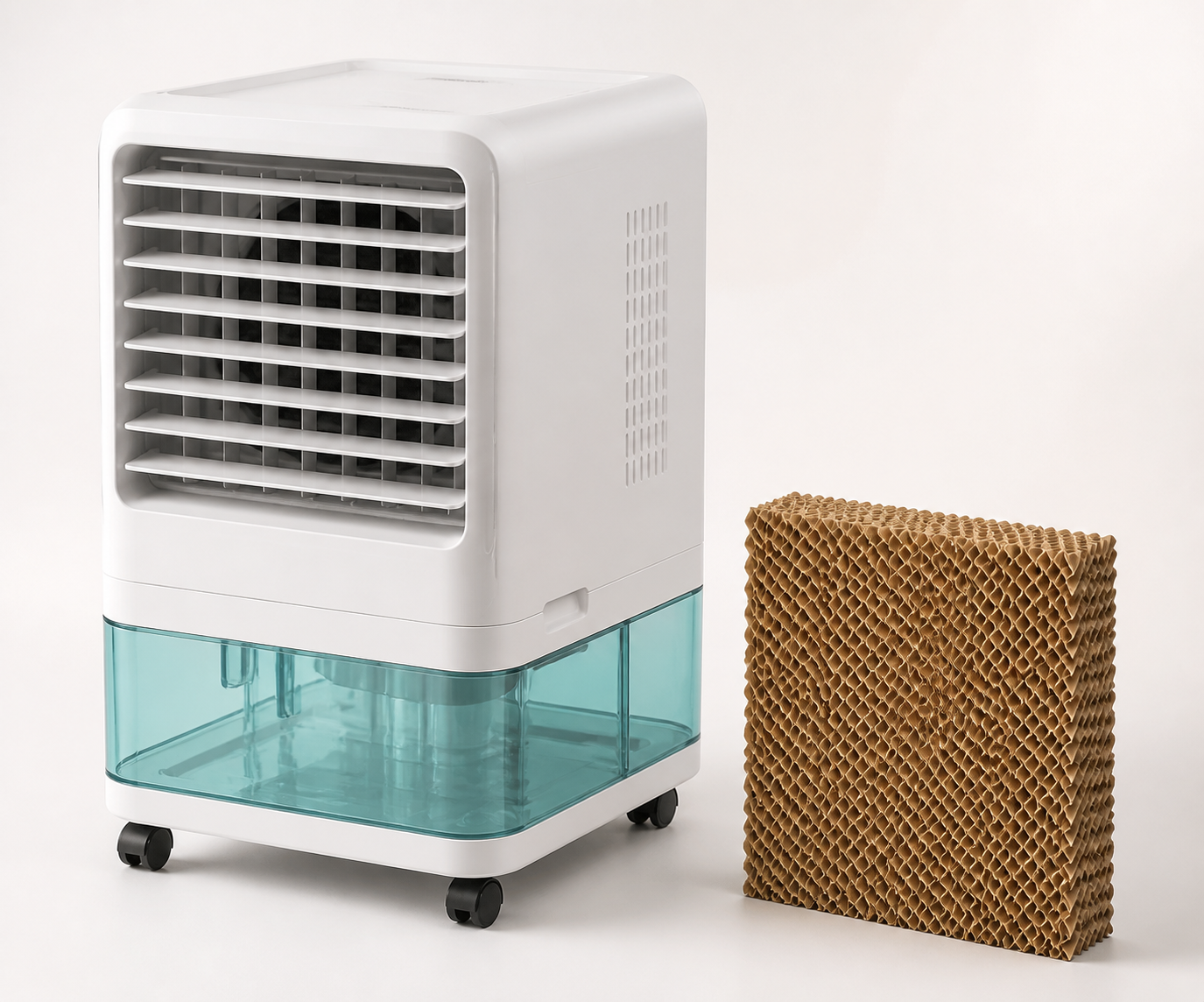
Evaporative air cooler vs fan vs portable AC
| Decision factor | Portable fan | Evaporative air cooler | Portable AC |
|---|---|---|---|
| Core mechanism | Moves air toward the user | Moves air through a wetted cooling medium | Refrigeration cycle removes heat from indoor air |
| Best positioning | Personal airflow, desk, travel, outdoor or retail impulse purchase | Personal cooling zone in suitable dry, ventilated conditions | Room-cooling solution where exhaust installation is feasible |
| Climate sensitivity | Less sensitive to humidity | Strongly affected by humidity and ventilation | Less dependent on outdoor humidity for its cooling mechanism |
| Consumables / upkeep | Usually low: cleaning grille and charging system | Water management, pad cleaning or replacement, drying and hygiene guidance | Filter maintenance, condensate/exhaust management, installation support |
| Buyer risk | Overstated runtime or airflow claims | Overstated room-cooling claims or poor fit for humid markets | Underestimated installation, noise, transport and service burden |
| Useful retail proof | Runtime by speed, noise condition, form factor | Water tank, pad, airflow mode, maintenance explanation | Exhaust kit, room-use limits, energy and installation information |
The table is deliberately practical. A distributor should not copy it into packaging unchanged. Instead, turn it into a selection brief that reflects the destination climate, the intended retail price band, the final product specification and applicable local rules.
1. Start with climate and ventilation, not the product photo
Evaporative cooling is a phase-change process: water absorbs heat as it evaporates. That principle is useful, but the real-world outcome depends on the air’s existing moisture content, the rate of airflow through the wet medium, the product’s water-management design and the ability to exchange air in the space.
For dry, hot markets, a portable evaporative air cooler can be positioned as water-assisted personal cooling in a ventilated area. It is particularly useful when buyers want a visible water-tank story, a cooling pad demonstration and an accessible alternative between a fan and fixed air conditioning. In this context, clear retail language matters: “personal comfort zone” is more defensible than “cools every room.”
For humid markets, a fan category may be easier to position. It avoids adding water to the air and gives the end user simple, targeted airflow. Misting products can still be relevant for certain outdoor uses, but the product application must be explicit: distance from the user, refilling routine, wind conditions and whether the product is intended for open-air use rather than a closed room.
Portable AC is a separate procurement decision. It involves an exhaust route, electrical load, service expectations and a much larger logistics footprint. Do not use a portable AC comparison merely to make a compact air cooler appear more powerful. Explain the different mechanism and let the customer choose the solution that fits the site.
Questions to put in the buyer brief
- What are the typical high-temperature and high-humidity months in the target market?
- Is the product for a desk, bedside, patio, travel case, retail display or enclosed room?
- Can the user open a window or provide cross-ventilation?
- Is water refilling and pad maintenance acceptable for the channel?
- Which claim can the buyer support with the final sample and test condition?
The answers determine the assortment. A balanced summer range may include fans for broad everyday demand, mist or wearable products for outdoor mobility, and water-assisted coolers for markets and use cases where the evaporation story is credible.
2. Translate the use case into a product specification
Once the application is defined, compare the product parameters that the end user will actually experience. For a fan, this often means speed settings, airflow direction, runtime by speed, charging interface, weight, grip, standing or hanging options, and sound level under the stated test condition. For an air cooler, add tank capacity, pump mode, pad material, filter access, visible water level, water-empty behavior, cleaning access and whether a fan-only mode is available.
Avoid comparing a single headline number without context. A battery capacity alone does not prove runtime; runtime changes with motor load, speed, battery condition, electronics and test method. A water-tank size alone does not prove how long a cooler will run; pump settings, environment and operating mode matter. Ask the factory to show the test setup, the sample revision, the selected speed and the pass criterion behind any number proposed for a datasheet.
During sample review, use the product application as the test frame. A desk fan should be checked on a stable desk surface, not only in a fixture. A wearable fan should be checked for comfort, hair-snag risk, charging-port accessibility and control visibility. A personal air cooler should be checked for filling, draining, louver adjustment, water leakage, pad access and drying instructions. These observations create usable instructions, not just a laboratory checklist.
3. Plan maintenance and installation preparation before purchase
An honest product story includes the work required after unboxing. For evaporative products, installation preparation is usually simple but not zero: the user may need a level surface, clean water, adequate air exchange and access for refilling and cleaning. The manual should explain the correct order for filling, operating and drying the unit. It should also tell users what to do after a period of storage.
For an importer, maintenance information should be reviewed before artwork approval. Confirm which languages are required, who supplies the safety wording, whether the water-tank markings are clear, and whether spare pads or filters are expected in the channel. The goal is to stop preventable service cases before they start.
For portable AC, installation preparation is more substantial. Confirm the exhaust kit, compatible window assumptions, cord length, drainage mode, local plug, handling weight and after-sales path. These are not minor details; they determine whether the product fits the end user’s home and the retailer’s returns policy.
4. Use factory testing and shipment inspection to protect the category promise
Cooling products are often purchased before the hottest weeks of the year, so a late quality issue is commercially expensive. A useful control plan begins with an approved golden sample and a written specification. It should identify the visual standard, color reference, packaging configuration, accessories, electrical input, charging behavior, function checks and claim-verification method.
At factory testing, a buyer can request evidence of the tests appropriate to the product: basic operation at each speed, charging and indicator function, control response, water-path and leak checks for water-assisted models, packaging-drop assessment where agreed, and review of the final instructions. The exact protocol must match the model and market; a generic checklist cannot replace product-specific testing.
At shipment inspection, check the final production revision rather than an early sample. Confirm carton markings, quantity, barcode position, plug or adapter version, accessory count, cosmetic condition and functional sampling. Photograph the pallet labels and retain the inspection record with the purchase order. If a change in motor, cell, pump, PCB or packaging has been proposed, treat it as a change-control event and decide whether a new sample is needed.
Frequently asked questions
Does an evaporative air cooler work in humid weather?
It can still deliver airflow, but the evaporative contribution is often reduced as humidity rises because the air has less capacity to take up water. Buyers should validate the product in the target climate and position it as a personal, water-assisted product rather than make universal temperature-drop claims.
Is an air cooler the same as a portable air conditioner?
No. An evaporative air cooler uses water, airflow and a wetted medium. A portable AC uses refrigeration and typically needs an exhaust arrangement. They have different installation, maintenance, energy and customer-expectation profiles.
What should appear on an air-cooler product page?
Show the intended space or personal-use scenario, water-tank capacity, operating modes, pad or filter maintenance, fill/drain method, product dimensions, input power, included accessories and the conditions behind any performance statement. Include a clear note that the final experience varies with climate and ventilation.
Should retailers stock fans and evaporative coolers together?
Often yes, if the range is merchandised by use case. Fans provide simple personal airflow across many climates. Evaporative coolers add a water-assisted option for suitable climates and customers who accept refilling and maintenance. Clear comparison signage reduces returns and improves cross-selling.
Conclusion
The strongest cooling assortment is not built around the most dramatic claim. It is built around fit: the local climate, the user’s space, the desired maintenance level and the evidence behind every specification. Fans, evaporative air coolers and portable AC products can coexist in one program when each is positioned for the job it is designed to do.
EXTERNAL RESOURCES
Official references
Use these primary resources alongside the final product specification and destination-market requirements.