PRODUCT SOURCING
How to Choose Rechargeable Portable Fans for Retail: Battery, Airflow, Noise and Safety Checklist

Rechargeable portable fans are simple to demonstrate and easy to add to a summer range, but they are not simple to source well. A model that looks strong in a studio photo can disappoint because its grip is awkward, its speed labels are unclear, its high-speed runtime is not explained, its charging cable does not match the channel, or its battery documentation is missing when a shipment is booked.
IN THIS ARTICLE
- 01Direct answer: what should buyers compare first?
- 021. Define the product role before selecting a fan format
- 032. Compare airflow and noise in a usable way
- 043. Understand battery capacity, watt-hours and runtime
- 054. Treat charging, protection and safety as a product system
- 065. Build factory testing into the sample and production process
- 076. What to verify during shipment inspection
- 08Frequently asked questions
- 09Conclusion
Introduction
For a retailer or importer, the best portable fan is the one that matches a defined shopper, channel and price point—and can be supported by clear specification evidence. That requires a more disciplined review than comparing battery capacity or headline motor speed alone.
This article gives a practical selection framework for handheld, desk, clip-on, foldable and wearable fan formats. It also explains what to request during sampling, factory testing and shipment inspection. It is not a substitute for destination-market compliance advice or final product testing; those requirements depend on the model, battery, charger and country of sale.
Direct answer: what should buyers compare first?
Start with use case, airflow delivery, runtime by speed, noise in the intended setting, charging system, battery safety documentation and finish quality. Then test the approved sample as a customer would: hold it, place it on a desk, clip it to the intended surface, fold it, charge it and run it at each speed. A portable fan program is successful when its specification, packaging and real use experience tell the same story.
Retail listings commonly compare airflow rating, runtime at different speeds, battery type, recharge time, noise, weight and positioning features. U.S. CPSC battery guidance supports a careful battery-safety review. B2B buyers should extend the review to battery documents, change control, packaging and pre-shipment inspection.
1. Define the product role before selecting a fan format
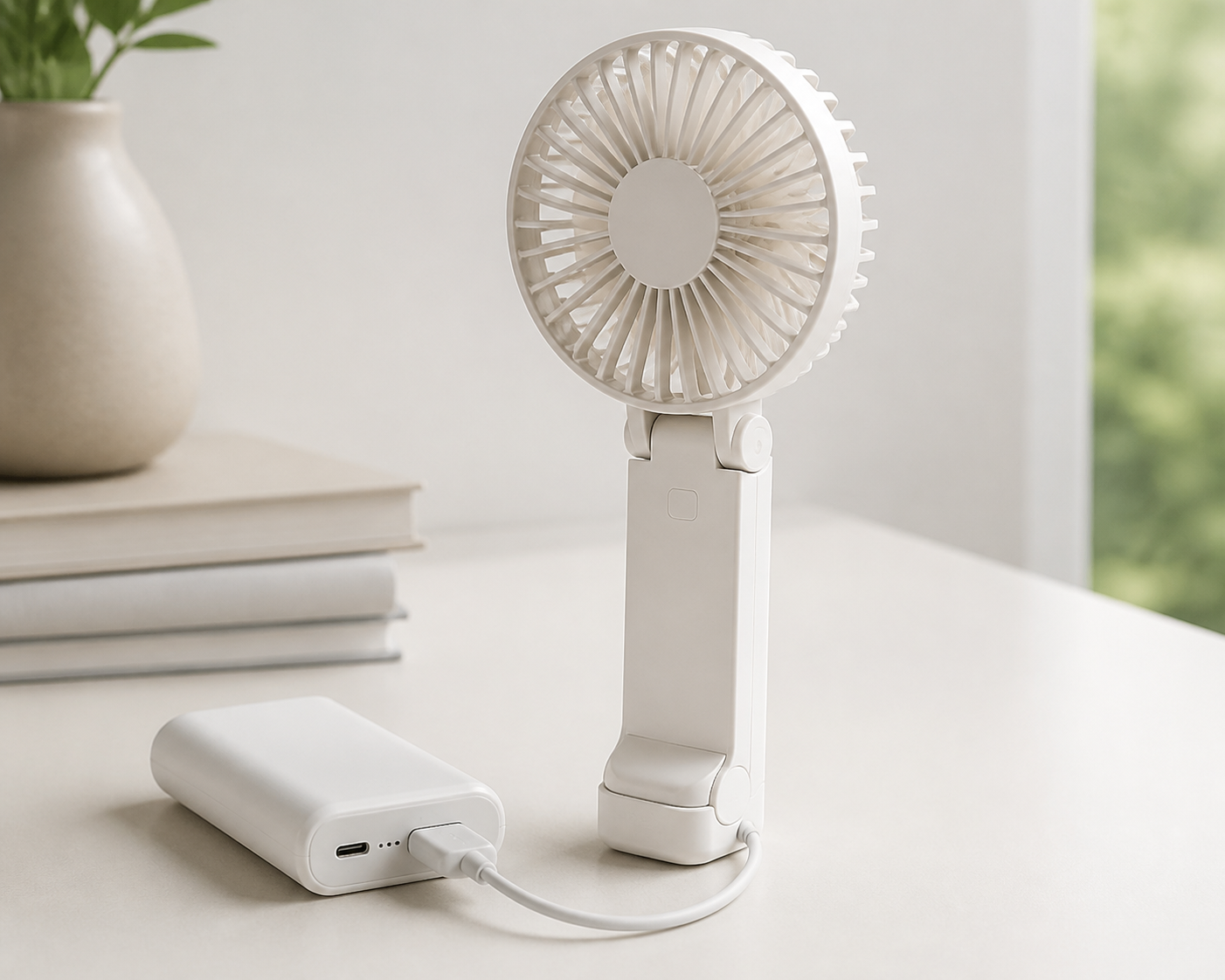
Every portable fan has a job. A mini handheld fan is an impulse-friendly personal item for commuting, events and seasonal checkout displays. A desktop fan needs stable placement, adjustable direction and a sound profile suitable for focused work. A clip-on fan needs a secure clamp, usable opening range and stable head adjustment. A foldable travel fan needs a reliable hinge, compact storage position and a good balance between stand function and portability. A wearable neck fan needs comfort, hair-management considerations, safe air outlets and controls the user can find without looking.
Write the intended product application in one sentence before requesting samples. For example: “A rechargeable desk-and-travel fan for office workers, packed in a shelf-ready carton and designed for low-to-medium speed use at a desk.” That sentence helps the factory prioritize the correct balance of motor, battery, form factor, noise and packaging. It also makes it easier to reject a sample that is technically functional but wrong for the customer.
A simple format-selection matrix
| Format | Best commercial role | Key sample checks | Common avoidable issue |
|---|---|---|---|
| Handheld fan | Travel, gifting, outdoor impulse | Grip, trigger/button feel, weight, high-speed heat and runtime | Promising maximum runtime without stating speed |
| Desk fan | Office, bedside, study | Base stability, tilt, control visibility, noise | Product vibrates or drifts on smooth surfaces |
| Clip-on fan | Stroller, pram, desk edge, camping | Clamp pressure, jaw opening, head position, finger-safe grille | Clamp marks surfaces or loses position |
| Foldable fan | Travel retail, compact home use | Hinge cycle, stand stability, folded thickness | Hinge feels loose after repeated use |
| Wearable neck fan | Commuting, events, walking | Neck comfort, air direction, hair interaction, control access | Air outlet or intake is poorly positioned |
The matrix is a starting point, not a specification. The final product file should define dimensions, material, operating modes, battery and charger details, accessories, carton configuration and instructions for the selected model.
2. Compare airflow and noise in a usable way
Airflow is not only about a dramatic top-speed setting. Buyers should ask how the airflow is directed, how many usable speeds exist, whether the motor response is consistent, and how the experience changes when the battery is not fully charged. A high-speed mode may be appropriate for a short outdoor relief use case, while a lower, quieter setting may be more valuable in an office or bedside program.
Ask the supplier to identify the test method behind any airflow, air-speed or noise figure. At minimum, request the sample revision, test distance, selected speed, background condition and whether the result is typical or maximum. Do not place a number in marketing copy simply because it appears on an early quotation sheet.
Noise deserves the same discipline. A decibel result is only meaningful with distance, mode and environment. In a product application review, run the sample in a quiet room and record user observations alongside the test data. Does the sound contain a high-pitched tone? Does the fan vibrate on a desk? Does the airflow feel focused or scattered? These details can determine whether a model belongs in an office assortment or an outdoor one.
3. Understand battery capacity, watt-hours and runtime
Battery capacity is often shown in milliamp-hours (mAh), but mAh is not a complete comparison between different voltage systems. Watt-hours (Wh) express stored energy more directly because they combine voltage and capacity. A buyer does not need to calculate every product’s battery system from scratch, but should ask the factory to provide the cell configuration, nominal voltage, Wh rating, charging input, charge time, protection design and runtime at each operating mode.
Runtime must be presented honestly. “Up to” runtime may be useful when it is tied to the lowest operating mode and a defined sample condition. It should not be used to imply that the high-speed mode runs for the same period. A clear datasheet can list approximate runtime by speed, note the test condition and state that actual use varies with environment and battery age.
For lithium-battery products, transport documents matter as much as an attractive runtime claim. IATA explains that manufacturers and subsequent distributors of lithium cells and batteries must make available a test summary showing that the cell or battery type has met UN Manual of Tests and Criteria 38.3 requirements. Read IATA’s guidance. Confirm the document belongs to the relevant battery type and that the forwarder has the information needed for the planned transport mode.
4. Treat charging, protection and safety as a product system
A rechargeable fan is not only a motor and a battery. It is a system made of cells, pack, protection circuit, charging input, cable or adapter, firmware or control board, housing and end-use behavior. The U.S. Consumer Product Safety Commission advises a system approach for battery-powered products, including cells suited to intended loads, appropriate battery management and testing of the end product with its charger. See CPSC’s battery guidance.
During product development, ask these questions:
- What is the charging input and cable type supplied?
- Which protection functions are built into the pack and charging path?
- What happens if the fan is operated while charging?
- Is the temperature rise at high speed reviewed in the agreed test plan?
- Are the battery, charger and final product tested as the intended system?
- Which destination-market markings, warnings and documentation are applicable?
The answer should be documented, not improvised by marketing. A reliable supplier distinguishes what has been tested on the final model from what is still under evaluation.
5. Build factory testing into the sample and production process
The most productive factory testing begins before the purchase order. Approve a golden sample and retain the key criteria: color, texture, assembly gaps, button feel, operating modes, charging behavior, accessories, carton artwork and instruction content. If the project includes custom color, logo, packaging or a new mold, record the revision number on the sample approval.
For a portable fan, a sensible product-specific test plan can cover:
- Power-on, speed-change and indicator behavior.
- Charging input and cable fit.
- Runtime review by the agreed operating modes.
- Motor sound, vibration and abnormal noise.
- Grille, hinge, clamp or neckband function for the selected format.
- Cosmetic review, drop or packaging checks where agreed.
- Battery and charger documents required for the shipment and market.
The exact limits belong in the purchase specification. Do not use a generic pass/fail standard across every fan shape and price point. A clip-on product needs clamp checks; a folding product needs hinge-cycle checks; a wearable product needs comfort and air-outlet checks.
6. What to verify during shipment inspection
Shipment inspection should confirm that the factory is producing the approved version, not merely that some units turn on. Select units according to the agreed inspection plan, then verify model number, color, plug/cable version, accessory count, barcode, carton quantity, product condition, fan operation and packaging. Compare the final units against the approved sample and artwork.
Pay particular attention to silent substitutions. Changes to the cell supplier, battery-pack configuration, motor, PCB, charger, cable, grille material or packaging may affect claims, safety documentation or customer experience. Require written notice for material changes and decide whether a fresh sample review, document check or retest is necessary.
Photograph carton labels, pallet configuration and any discrepancy. Keep the inspection report, final invoices, battery document set and product instructions together. This record helps sales teams answer retailer questions and gives the buyer a traceable file if a service issue appears later.
Frequently asked questions
Is a higher mAh number always better?
No. Capacity is one part of the system. Compare the battery voltage and Wh rating, runtime by speed, charging time, product weight, motor load and the evidence behind the stated result. A larger battery can improve runtime but may also change size, weight and transport considerations.
What noise level should a retail buyer ask for?
Ask for the figure with its test conditions, then listen to the production-representative sample in the intended use case. A number without distance, mode and background condition is incomplete. Office-oriented fans usually need a different sound profile from outdoor handheld products.
Can a supplier’s UN38.3 document be reused for every model?
Only if it relates to the relevant battery type and configuration used in the product. Confirm the documentation with the supplier and freight forwarder before shipment. Model changes, battery changes and transport mode can require an updated review.
What should be printed on portable-fan packaging?
Packaging should reflect the final model and destination: product identity, operating or charging information, required warnings, importer/manufacturer information where applicable, included accessories and the conditions behind any runtime or performance claim. Confirm language and marking requirements before artwork approval.
Conclusion
A portable fan is an accessible product category, but it rewards disciplined sourcing. Start with the user and channel, then test airflow, runtime, sound, comfort, charging and finish in the way the customer will actually use the product. Treat battery documents, change control and shipment inspection as part of the product—not as paperwork after the order is complete.
EXTERNAL RESOURCES
Official references
Use these primary resources alongside the final product specification and destination-market requirements.