PRODUCT SOURCING
Desk Fan Wholesale: A Buyer Guide to Suppliers, OEM Programs and Quality Checks

Desk fan wholesale projects are often judged by a simple photo and a unit price, but the successful B2B program is decided by the details behind them. Desk placement, airflow angle, base stability, control feel, operating sound, charging arrangement, packaging and seasonal delivery all influence whether a distributor or retailer can present the product accurately.
IN THIS ARTICLE
- 01Direct answer
- 02Define the desk-fan use case first
- 03What to ask a desk fan manufacturer
- 04Desk fan OEM: distinguish branding from development
- 05Compare rechargeable desk fan options with a test basis
- 06How desk fan MOQ affects the sourcing plan
- 07Mid-article CTA: request a desk-fan comparison
- 08Frequently asked questions
- 09Conclusion
- 10CTA: request a catalog and quality checklist
Introduction
This guide helps importers, private-label buyers and promotional teams evaluate a desk fan supplier. It explains how to create a useful request for quotation, compare existing models with OEM changes, document testing and prepare a practical shipment-inspection plan.
Direct answer
Buyers should select a desk fan supplier after comparing the exact product configuration, intended desk or countertop application, motor and battery arrangement, packaging, evidence of testing and production-control process. A product image alone cannot establish airflow suitability, stable operation or bulk consistency; the approved sample and written product file should control the order.
Define the desk-fan use case first
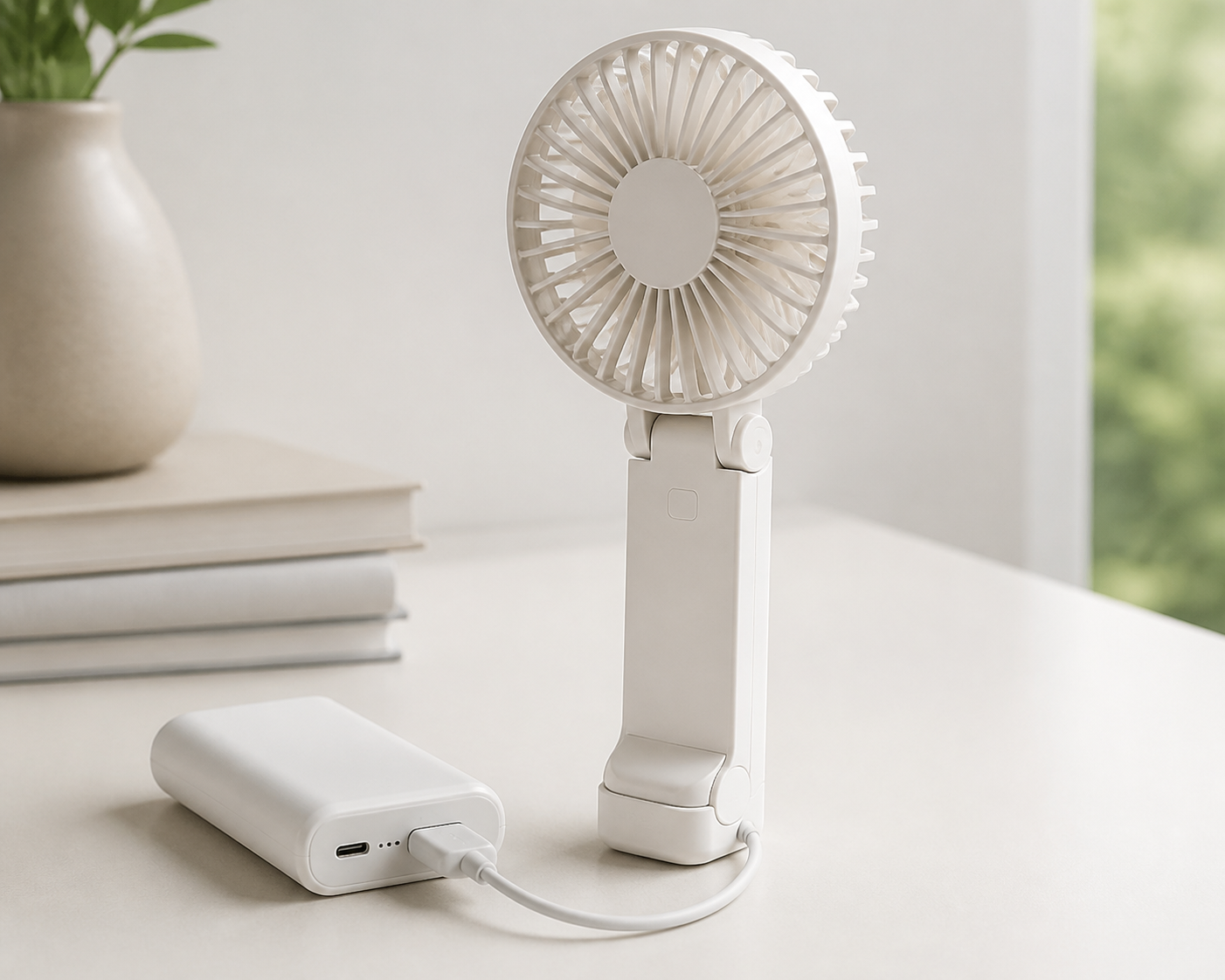
Desk fans produce local airflow for personal comfort. They are not substitutes for a room air-conditioning system, so product claims should describe a personal airflow application rather than an unsupported room-cooling promise. A compact fan in a home-office, checkout counter, dormitory, travel setting or promotional bundle can require very different tilt ranges, footprint, cable arrangements and runtime expectations.
Create a buyer brief with six inputs
- Channel and user. Identify whether the program is for e-commerce, stationery retail, gift channels, workplace supply, travel retail or an event. State the expected desk, counter or bedside scenario.
- Product geometry. Specify approximate height, base footprint, grille style, blade or bladeless format, orientation adjustment and acceptable packed size.
- Performance context. Ask how airflow, speed levels, operating sound and runtime were observed. A number without an operating mode, distance or test basis should not become retail copy.
- Power arrangement. Confirm USB input, included cable, battery capacity where applicable, adapter position and charging-indicator behaviour.
- Brand and pack. List colour, logo, product name, barcode, instruction language, accessories, retail carton and master-carton requirements.
- Launch schedule. Allow time for samples, artwork proofing, pre-production approval, quality inspection and freight before the selling season.
What to ask a desk fan manufacturer
A credible desk fan manufacturer should identify the proposed model revision and explain which parts are standard, which changes are feasible, and how a component change is controlled. Ask for a configuration sheet that names the motor, battery or power route, speed controls, cable, base, grille, colour, accessories and package contents.
| Control area | What to ask | Buyer record |
|---|---|---|
| Product identity | What exact model and components are offered? | Dated spec sheet and sample photos |
| Desk application | What is the base size, tilt range and intended placement? | Buyer use-case notes |
| Functional test | How are speed, control response and charging checked? | Factory test method |
| Pack readiness | Which label, insert and barcode items are supported? | Artwork and packing checklist |
| Production control | How are approved changes and defects recorded? | Pre-production and inspection plan |
Evaluate stability and handling, not only airflow
During sample review, place the fan on the surfaces expected in the product application. Operate each speed, change the angle, use every control and observe whether the base stays stable during ordinary adjustment. Inspect grille fit, finish, gaps, cable exit, port alignment, switches, indicators and any folding or clip mechanism.
Operating sound should be described with the mode and distance used for the observation. A buyer does not need to repeat every factory test, but should ensure the factory's test method is meaningful for the agreed product. Retain the sample record with the model code and photographs so a different colour, motor, PCB, battery, cable or accessory cannot be mistaken for the approved configuration.
Desk fan OEM: distinguish branding from development
Desk fan OEM can be a logo on an established platform, a private-label colour and retail carton, or an extended program involving a new base, tool, control layout or electronics. These routes have different cost, MOQ and delivery implications.
For an existing item, request the printable area, colour process, approved logo artwork, packaging dieline and barcode placement. For a deeper project, define tooling scope, ownership, development samples, feature validation, artwork milestones and change approvals in writing. Avoid calling an ordinary private-label version an exclusive product unless the agreed development scope and commercial rights actually support that description.
Compare rechargeable desk fan options with a test basis
A rechargeable desk fan needs a clear runtime context. Battery capacity alone does not show expected use time because selected speed, starting state of charge, ambient conditions and the test endpoint all influence the result. Ask the supplier to describe the test setting behind the claimed range.
Confirm rated capacity and watt-hour information, input connection, included cable, charge-state indicator, expected input power and whether an adapter is included. For battery-powered orders, share the final product and battery details with the forwarder in advance. Consult IATA lithium battery shipping guidance as a general reference and verify the final route with the carrier or forwarder.
Make testing and inspection part of the product file
Factory testing should identify the model, unit quantity, test condition, duration and result. Suitable checks can include power-on response, speed selection, indicator behaviour, charging, abnormal noise, vibration, visual finish and packaging content. The objective is a repeatable control—not an exaggerated performance claim.
For shipment inspection, use the approved sample and a written checklist. Inspect a production sample for appearance, functions, tilt mechanism, base stability, accessories, labels, instructions, retail carton and master cartons. If customer requirements include a logo colour or a barcode scan, make each a stated inspection point. This prevents late findings from becoming ambiguous acceptance discussions.
How desk fan MOQ affects the sourcing plan
Desk fan MOQ can vary by existing platform, body colour, logo process, battery option, accessories and retail packaging. A lower quoted unit price may assume a generic carton, a larger quantity, a standard cable or a different configuration from the buyer brief.
Ask for minimums broken down by model, colour, printed component and packaging. Then compare them with a realistic demand plan and storage limit. For a seasonal product, the commercial decision should consider replenishment lead time and end-of-season stock exposure, not just factory unit cost.
Mid-article CTA: request a desk-fan comparison
Frequently asked questions
What should a desk fan wholesale quote state?
It should identify the exact model, power or battery configuration, speed modes, cable and accessories, colour, packaging, MOQ, estimated lead time, quality assumptions and delivery terms. It should separate confirmed scope from decisions that still need buyer approval.
How should buyers select a desk fan supplier?
Choose a supplier that can document the proposed configuration, support controlled samples, explain quality checks and manage packaging and delivery details. Compare the total product scope and evidence before comparing the headline unit price.
Does desk fan OEM always require new tooling?
No. Many OEM programs use an established platform with custom branding, colour or packaging. New tooling may be needed only when the base, housing, controls or other structural parts change. Confirm that point before setting an MOQ or launch date.
What should be checked before a desk fan shipment?
Check the production goods against the approved file: model, finish, operation at each mode, base stability, angle adjustment, charging response, accessories, labels, instructions, retail packaging and cartons. Keep the inspection report with the purchase-order file.
Conclusion
Desk fan wholesale sourcing is more reliable when the product application, exact configuration, test method, OEM scope and inspection points are documented before bulk production. This gives suppliers a clearer execution brief and lets buyers make credible product statements to their own customers.
CTA: request a catalog and quality checklist
Send your requirements to [info@chillnexa.com](mailto:info@chillnexa.com) to request a desk-fan catalog, sample checklist and private-label quotation.
EXTERNAL RESOURCES
Official references
Use these primary resources alongside the final product specification and destination-market requirements.