PRODUCT SOURCING
Handheld Fan Wholesale: How B2B Buyers Assess Suppliers, OEM Scope and Quality

Handheld fan wholesale programs look straightforward until a buyer compares how the item will actually be held, charged, packaged, shipped and sold. A compact fan for commuting or event distribution may be selected for portability, while a premium retail model may need a display, a stronger battery, a specified colour finish and a controlled retail presentation. These are different buying briefs even when the product silhouette is similar.
IN THIS ARTICLE
- 01Direct answer
- 02Define the customer use before choosing a model
- 03What a handheld fan manufacturer should document
- 04Handheld fan OEM: define the level of customization
- 05Compare rechargeable handheld fan models in context
- 06How handheld fan MOQ shapes the commercial decision
- 07Mid-article CTA: compare your program
- 08Frequently asked questions
- 09Conclusion
- 10CTA: request a handheld fan catalog
Introduction
This guide gives importers, distributors and private-label teams a practical method for evaluating a handheld fan supplier. It covers product definition, sampling, OEM choices, rechargeable product checks, MOQ analysis and the factory-to-shipment controls that help an approved sample remain representative of bulk goods.
Direct answer
Buyers should choose a handheld fan supplier by comparing a named configuration against the intended user and channel. Confirm model revision, airflow format, controls, battery or power arrangement, included accessories, packaging, sample record, testing method, inspection plan and delivery responsibilities before treating a quotation as comparable.
Define the customer use before choosing a model
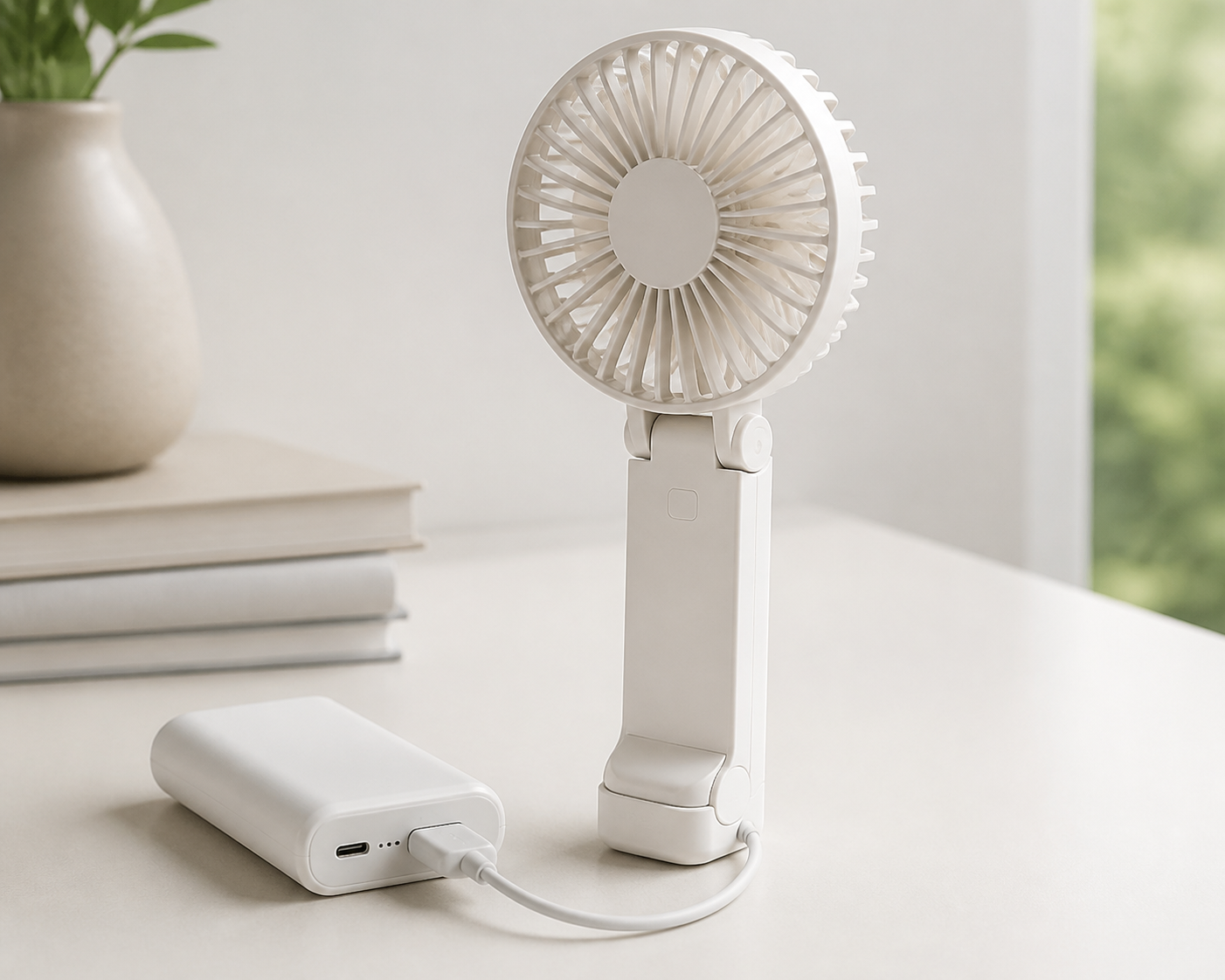
Handheld fans create personal airflow. They should be described as a local-comfort product rather than as a replacement for room cooling. This matters for product copy and for sourcing: the buyer should decide whether the main scenario is travel, commuting, event use, outdoor queues, retail gift bundles, office breaks or a more general consumer category.
Six buyer inputs for a useful quotation
- User and channel. State whether the product is intended for mass retail, e-commerce, promotional distribution, travel retail or a distributor catalogue.
- Product format. Specify foldable, stand-capable, clip, mist, direct-blade or enclosed-blade format, plus acceptable size and packed weight.
- Operation. Confirm speed levels, controls, indicator expectations, airflow direction and the customer-facing runtime statement that can be supported.
- Power configuration. Identify USB input, cable inclusion, battery capacity, watt-hour information and whether an adapter is included or excluded.
- Brand and packaging. Define colour, logo, carton, insert, barcode, instruction language and any retail display requirements.
- Delivery plan. Work back from the selling date to allow time for samples, artwork, production approval, shipment inspection and freight.
What a handheld fan manufacturer should document
A capable handheld fan manufacturer should identify the proposed product by model and revision, not only by catalogue image. Ask which components are standard, which have been changed for the quotation, and how the factory records a motor, battery, PCB, material, cable or packaging change after sample approval.
| Review area | Buyer question | Evidence to retain |
|---|---|---|
| Product identity | Which model, colour, battery, cable and accessories are included? | Dated specification and sample photographs |
| Product application | Who will hold or place the product, and in what scenario? | Customer requirements brief |
| Functional control | How are speeds, charging, indicators and noise checked? | Factory testing record |
| Retail readiness | Which packaging, instruction and barcode items are supported? | Artwork approval checklist |
| Delivery control | When are production, inspection and freight release planned? | Purchase-order milestone plan |
Treat the approved sample as a controlled reference
During sample review, test each speed, controls, charge indication and cable connection. Check the fan's handling, switch feel, grille or blade protection, finish, seams, accessories and proposed individual box. Observe operating sound at a documented distance and speed rather than using a general description such as “quiet.”
Record the model code, date, sample condition and required corrections. Before production, review the approved version, final package artwork, accessory count and key defect criteria with the supplier. If any component changes, decide whether a revised sample or a revised test record is needed. This simple change-control step prevents a well-reviewed early sample from being confused with a different production configuration.
Handheld fan OEM: define the level of customization
Handheld fan OEM can range from a logo on a factory platform to a custom colour, retail carton, accessory set, mould or electronic feature. Each route has different timing, cost and approval risk. Buyers should separate “private label on an existing product” from “new product development” in their requests and purchase-order terms.
For an established platform, ask for print-area limits, decoration method, colour standard, artwork template and packaging dieline. For a development project, document tooling, ownership, validation samples, development lead time, feature requirements, approved milestones and responsibility for design changes. Avoid presenting a logo-only variant as a unique design unless the actual product-development arrangement supports that claim.
Compare rechargeable handheld fan models in context
A rechargeable handheld fan needs a runtime statement tied to a known condition. Runtime varies by speed, starting charge, battery condition, ambient temperature and the factory's endpoint. Request the method behind any runtime range, including operating mode and whether the unit started from a full charge.
Confirm rated battery capacity and watt-hour information, input port, cable, indicator behaviour, expected charging input and adapter position. For international freight, align the final product and battery records before the cargo is booked. IATA's lithium battery guidance provides general context; the final forwarder and carrier requirements must still be confirmed for the actual route and product.
Plan factory testing and shipment inspection together
Factory testing should identify the exact model, quantity tested, mode, duration and observed result. Relevant checks include power-on, speed selection, charge response, indicator behaviour, abnormal noise, vibration, visual finish and accessory count. It is better to retain a repeatable production record than to make broad performance claims without a test method.
At shipment inspection, compare production units with the approved file: model, colour, finish, function, controls, cable, instructions, labels, individual carton and master carton. Add any specific customer requirements—logo location, barcodes, language or retail inserts—to the checklist. A clear checklist allows the inspector to assess the bulk shipment against agreed criteria rather than personal interpretation.
How handheld fan MOQ shapes the commercial decision
Handheld fan MOQ can change by model, body colour, printing, battery option, accessory selection and packaging format. A lower unit quotation may rely on a standard colour, generic box, different cable or quantity that does not match the expected channel demand.
Ask the factory to separate the minimum quantity by model, colour, decoration and retail package. Compare the purchase commitment with the sales forecast, storage capacity, seasonal window and potential replenishment timing. The best commercial choice is the configuration that matches the selling plan and quality requirement—not necessarily the lowest quoted unit cost.
Mid-article CTA: compare your program
Frequently asked questions
What should a handheld fan wholesale quote include?
It should state the model, product configuration, colour, battery or power arrangement, accessories, package contents, MOQ, lead time, quality assumptions and delivery terms. It should distinguish confirmed scope from choices that remain open.
How should buyers select a handheld fan supplier?
Select a supplier that can document the exact model, control samples and changes, explain testing and provide a workable packaging, inspection and delivery process. Compare total product scope and evidence before comparing price.
Does handheld fan OEM mean a new product design?
Not always. OEM may be an established model with a logo, colour or packaging variation, or it may be a full development program. Clarify the actual customization, tooling and approval scope before setting expectations.
What should be inspected before a handheld fan shipment?
Check production units against the approved sample and file: model, finish, operation, controls, charging response, accessories, labels, instructions, retail pack and master cartons. Retain the report with the purchase-order and shipping records.
Conclusion
Handheld fan wholesale sourcing becomes more predictable when the customer use, exact configuration, sample approval, OEM scope and inspection criteria are controlled as one product file. That gives buyers a sounder basis for supplier comparison and clearer information for their own retail or distribution customers.
CTA: request a handheld fan catalog
Send your requirements to [info@chillnexa.com](mailto:info@chillnexa.com) to request a handheld-fan catalog, sample checklist and private-label quotation.
EXTERNAL RESOURCES
Official references
Use these primary resources alongside the final product specification and destination-market requirements.