PRODUCT SOURCING
Portable Fan Wholesale: How Buyers Choose a Supplier, MOQ and OEM Program

Portable fan wholesale sourcing is not simply a search for the lowest product price. Importers, distributors and private-label retailers need a product configuration that fits the intended customer, a supplier process that can reproduce the approved sample, and a delivery plan that supports the selling season.
IN THIS ARTICLE
- 01Direct answer
- 02Define the wholesale program before requesting a quote
- 03How to evaluate a portable fan manufacturer
- 04Portable fan OEM: when customization changes the buying process
- 05How to compare rechargeable portable fan options
- 06How portable fan MOQ affects the commercial decision
- 07Mid-article CTA: compare your program
- 08Frequently asked questions
- 09Conclusion
- 10CTA: Request a catalog and sourcing checklist
Introduction
This guide is for buyers comparing a portable fan supplier or portable fan manufacturer for retail, promotional, travel and personal-comfort programs. It explains how to move from a broad product request to a controlled quotation, sample and purchase-order process without turning a catalogue image into an unsupported retail promise.
Direct answer
Buyers should compare like-for-like product scope before choosing a portable fan supplier. Confirm the product format, motor and battery configuration, accessories, packaging, target quantity, test evidence, inspection plan and delivery terms. A credible quote identifies what is included, what is based on an existing platform and what still needs approval.
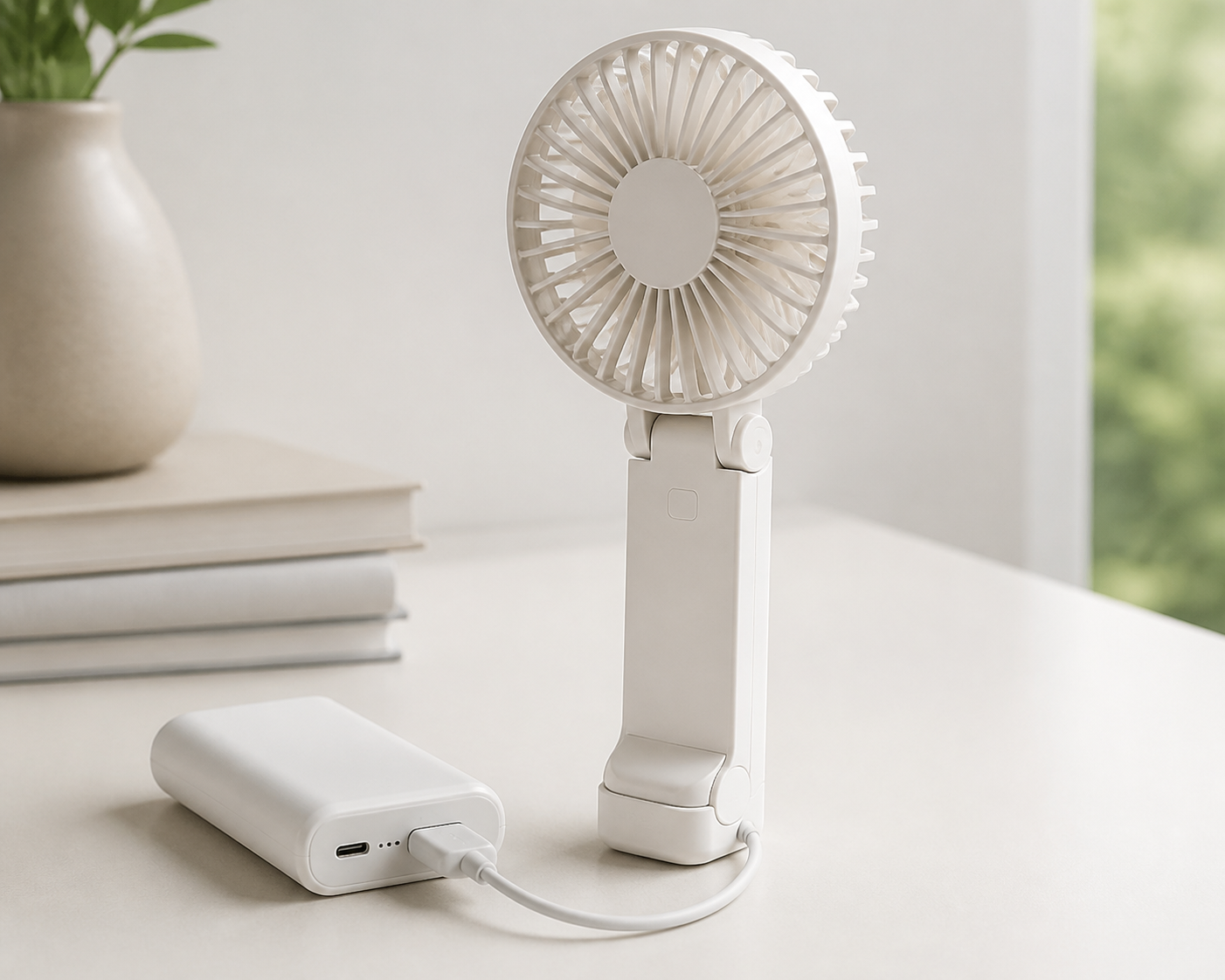
Define the wholesale program before requesting a quote
Begin with the intended customer and application. A rechargeable handheld fan for commuter retail, a folding fan for travel, a desk fan for office use and a mist fan for an outdoor event may look similar in a supplier catalogue while requiring different airflow direction, runtime context, package contents and service expectations.
Use six buyer inputs
- Customer and channel — Define whether the product is for mass retail, e-commerce, travel retail, promotion, a distributor catalogue or a seasonal event.
- Product format — State the required form factor, expected use position, controls, color and included accessories.
- Performance context — Ask how airflow, speed modes, noise and runtime were tested. A maximum figure without a stated mode or condition is not enough for customer-facing content.
- Destination market — Identify the intended country early so labels, instructions, battery records and product information can be planned against the final configuration.
- Packaging and brand — Specify whether the program requires a plain box, retail carton, sleeve, insert, barcode, logo or private-label artwork.
- Delivery window — Work backwards from the required selling date to allow time for samples, artwork approval, production, inspection and freight.
How to evaluate a portable fan manufacturer
The right portable fan manufacturer should be able to answer specific questions about the actual model offered, not only provide generic factory photographs. Ask the factory to identify the model revision, existing versus custom components, confirmed accessories, relevant production capability and the steps used to manage a component or packaging change.
| Review area | What the buyer should ask | Evidence to retain |
|---|---|---|
| Product identity | Which model, color, battery, cable and accessories are included? | Dated specification and sample photos |
| Product application | Who will use the fan, at what distance and in which setting? | Buyer brief and use-case notes |
| Factory control | How are samples, component changes and quality findings recorded? | Process summary and change record |
| Retail readiness | Which packaging, label, instruction and barcode details are supported? | Artwork checklist and product file |
| Delivery plan | What is the production window, inspection point and named delivery responsibility? | Quotation and purchase-order terms |
Verify the supplier beyond the first sample
An attractive first sample does not prove that a factory will ship the same configuration in bulk. During sample review, check the finish, assembly fit, controls, stability, airflow direction, noise, charging arrangement, accessories and proposed packaging. Record the model identifier and any observations that must be corrected before production.
At a pre-production review, reconfirm the approved sample, final artwork, package contents, carton configuration and critical quality points. If the supplier proposes a different motor, battery, PCB, material, color process, cable or retail insert, assess whether the previous sample and documentation still represent the final product.
Portable fan OEM: when customization changes the buying process
Portable fan OEM work can range from a logo on an established model to a new color, packaging design, accessory set or tooling program. The buyer should separate these routes because they do not carry the same timing, cost or approval risk.
For a low-change private-label program, confirm the factory platform, decoration method, artwork safe area, packaging dieline and barcode position. For a deeper customization project, put the product specification, ownership terms, sample milestones, component-change approval process and production release criteria in writing.
Do not describe a product as unique merely because a logo or color was added. Retail claims should match the actual product and the evidence available for that final configuration.
How to compare rechargeable portable fan options
A rechargeable portable fan should be compared with the selected operating mode and charging setup in mind. Buyers commonly need to verify battery type, rated capacity, watt-hours, charging input, supplied cable, adapter expectation, indicator behavior and runtime test condition.
For shipment planning, the final product and battery configuration should be tied to the relevant records before freight is booked. Battery-powered products may have route- and carrier-specific requirements, so coordinate early with the supplier and forwarder rather than treating battery information as a last-minute carton label task. Review IATA lithium battery shipping guidance together with the final freight provider requirements.
Test the product as a customer will use it
Factory testing is most useful when the test method is recorded. Note the exact model, operating mode, starting battery state where relevant, test duration, observed function and reviewer. For a retail program, also check handling, controls, noise character, visual finish, accessories and the actual package configuration.
Before shipment inspection, make sure the inspector has the approved sample reference and written defect criteria. The inspection should check the production-intent product rather than an early development sample, including function, cosmetic condition, accessory count, labels, instructions, inner pack and master cartons.
How portable fan MOQ affects the commercial decision
Portable fan MOQ often changes with the model, color, decoration, packaging, accessory selection and whether the factory is using an existing platform. A quote that appears lower can reflect a different color mix, a generic box, fewer accessories, a higher quantity or a longer production commitment.
Ask the supplier to break out the minimum quantity by model, color and packaging option. Then compare the commercial impact with the seasonal forecast and the cost of holding unsold stock. A lower per-unit price may not be the better decision if it requires a quantity that the planned channel cannot sell during the season.
Mid-article CTA: compare your program
Frequently asked questions
What should a portable fan wholesale quote include?
A useful quotation identifies the model, product configuration, color, battery or charging arrangement, included accessories, packaging, MOQ, lead time, applicable assumptions, inspection expectations and delivery terms. It should distinguish confirmed elements from open decisions.
How should buyers choose a portable fan supplier?
Choose a supplier based on the fit between the offered product, your target channel and the factory's ability to control samples, changes, quality checks, packaging and delivery. Compare product scope and evidence before comparing unit price.
Is an OEM portable fan always a new product design?
No. OEM can describe work on an established platform with brand, color or packaging changes, or it can involve a more extensive product-development project. Clarify the actual customization scope, approval milestones and ownership terms before starting.
What should buyers inspect before a portable fan shipment?
Check the production product against the approved file: model, color, function, controls, cosmetic standard, accessories, labels, instructions, retail pack and master carton. Retain the inspection report with the purchase-order record.
Conclusion
Portable fan wholesale success comes from aligning the customer need, product scope, supplier process and delivery plan. When the approved sample, quotation, testing record, packaging and final production goods refer to the same configuration, buyers can build more credible customer information and reduce avoidable revision or return risk.
CTA: Request a catalog and sourcing checklist
Send your requirements to [info@chillnexa.com](mailto:info@chillnexa.com) to request a portable fan catalog, sample checklist and private-label quotation.
EXTERNAL RESOURCES
Official references
Use these primary resources alongside the final product specification and destination-market requirements.